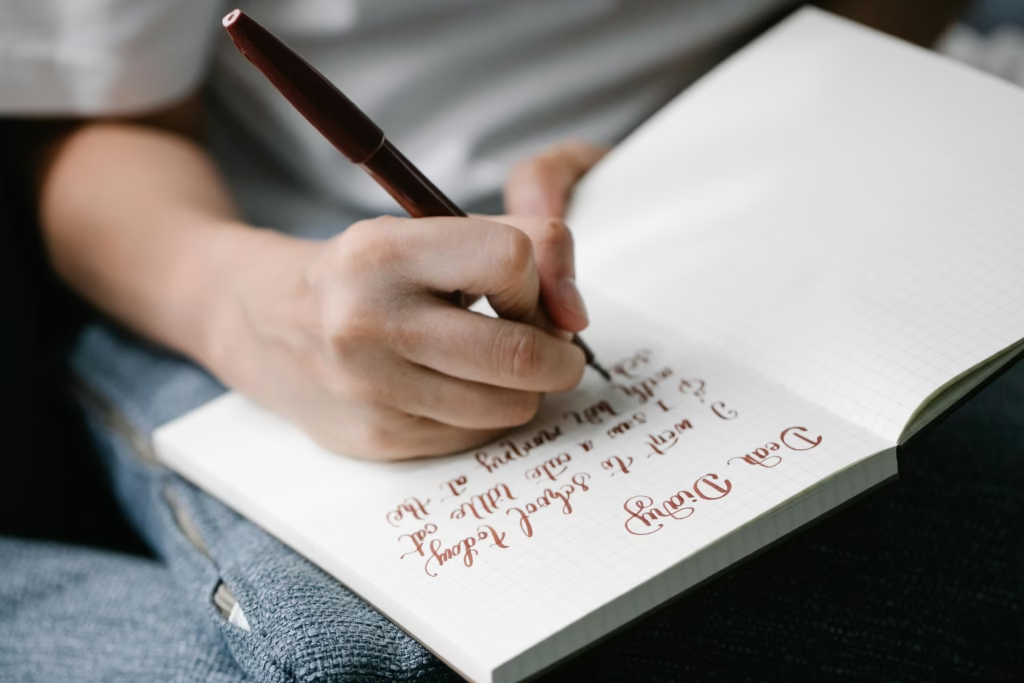

Let’s talk about journaling.
There are countless videos online where people share their journaling rituals. The perfect notebook. The perfect morning routine. The perfect prompts. Three pages before sunrise. Gratitude lists. Goal lists. Future-self letters.
And sometimes, without realizing it, we start to believe that we need to journal exactly the way someone else does.
But journaling is personal.
Your journal does not need to look like anyone else’s. It needs to fit your life, your season, your personality, and your energy.
Over the years, I have journaled in many different ways. Some practices stayed with me. Others lasted a few weeks and disappeared.
And I think that is the point.
You are allowed to change the way you journal as you change.

How Journaling Started for Me
When I was in middle school, journaling was simply a daily diary.
I wrote about what happened during the day, who did what, what someone said, and how I felt about it. I was not trying to extract a lesson from everything. I was simply recording my life.
I did that for many years and eventually stopped.
Later, when I began my self-development journey, I returned to journaling. At first, I tried going back to the same diary-style approach.
But after a few weeks, I started reading my old entries differently.
There were so many complaints. So, much blame. So much focus on what other people had done to me.
And strangely enough, that experience became useful.
Because journaling reveals you to yourself.
The page showed me a version of myself that I did not particularly like. I could see how often I was blaming, complaining, and seeing myself as a victim.
I didn’t need to judge that version of myself.
I simply needed to see her.
And once I could see her, I could begin to change.
Writing Goals and Creating Focus
My journaling gradually shifted from documenting what had happened to thinking about what I wanted to create.
I began writing down my goals and the things I wanted to experience.
For a while, I practiced something called the Sphere of Silence. The idea was to spend an hour each day in silence, with different parts of that hour dedicated to reflection, reading, writing, and devotion or meditation.
During that hour, I would ask myself questions such as:
- What do I want to achieve today?
- What do I want to achieve this week, this month, and this year?
- What do I want to create within three, five, or ten years?
- What did I learn today?
I would also read for a few minutes, write down the ideas that stood out to me, and spend time without devices.
I loved having my goals in front of me every day.
Over time, the notebooks became almost like a record of my thinking —a collection of reflections, lessons, questions, ideas, and things I was trying to understand.
Morning Pages and Thought Downloads
Another journaling practice I tried came from The Artist’s Way: writing three pages first thing in the morning.
The idea was simple. Empty your mind onto the page before the day begins.
I practiced it while reading the book but eventually stopped because the three-page requirement began to feel restrictive.
And that taught me something important.
Even when a method is useful, it does not necessarily mean it is useful for you forever.
Sometimes we turn a practice that was supposed to support us into another thing we feel we have to perform correctly.
I didn’t need another rule.
I needed a practice that worked with me.
Using One Goal as a Visual Anchor
At another point, I stopped writing long entries altogether.
Instead, I would take one sheet of paper and write a single goal at the top.
It could be something I wanted to happen that week, that month, or that year.
Then I would draw circles and sections around it and start writing.
How did I want the outcome to feel?
How did I want the situation to be resolved?
How did I want the goal to be created or built?
What did I want the final result to look like?
The page became a visual anchor.
I would put it somewhere I could see it. When I woke up, moved around the house, or passed by it during the day, I would look at it.
I was constantly returning to the picture in my mind.
That was one of the ways I manifested an apartment.
Whether you think of that as manifestation, visualization, focused attention, or simply keeping an idea consistently in front of your mind, there was something powerful about it.
The goal stopped being an abstract thought.
It became something I could see.
Writing Desired Outcomes During Stressful Seasons
When I started overseeing our rental business back home, journaling took another form.
There were stressful situations involving tenants, misunderstandings, and problems that needed to be resolved peacefully.
During those periods, I would take a small card and write down the outcome I wanted in the present tense.
For example:
“I am so glad this was resolved peacefully. The person agreed, and everything worked out in the most perfect way.”
I would keep the card in my wallet, take it to the office, put it somewhere I could see it, and read it repeatedly.
And surprisingly, it helped me many times.
I think part of the power was that it gave my mind somewhere to go.
Instead of repeatedly rehearsing the problem, I was repeatedly returning to the outcome I wanted.
I was not pretending that the problem did not exist.
I was reminding myself that the problem was not the only possible thing to focus on.
Journaling With Books, Podcasts, and Quotes
Sometimes I don’t journal because I have something specific I want to write about.
Sometimes something I read or hear gives me something to think about.
When I am reading a book or listening to a podcast and an idea opens my mind, I write it down.
Sometimes it is only a few sentences.
Sometimes it becomes several pages.
The idea becomes the prompt.
I have also used quotes this way.
My first one-to-one coaching client, Fatima, did not enjoy traditional journaling or structured prompts. So instead of giving her another journaling exercise to complete, I suggested that she use quotes.
One quote I shared with her was:
“Life is too short to be little.” — Benjamin Disraeli
I told her not to pressure herself.
Write the quote down.
Carry it with you.
Read it during the day.
Let it sit with you.
Eventually, the quote began to speak to her. It gave her something to reflect on, something to write about, and eventually something that helped her form a clearer destination in her mind.
Sometimes you don’t need another question.
Sometimes you just need one sentence that stays with you.
Choosing a Word of the Year
I also journal through my word of the year.
I choose a word that reflects the identity I am stepping into.
Sometimes the word stays with me for the entire year.
Sometimes, after several months, I realize I have outgrown it.
And that is okay too.
This year, my word is sovereign.
Once I chose the word, I began asking myself what it meant to be a sovereign woman.
What does she own?
How does she manage her resources?
How does she make decisions?
What does her home feel like?
How does she take care of the people connected to her world?
What does freedom look like for her?
The word became more than a word.
It became a doorway into another identity.
And that identity gave me things to write about.
Letting Ideas Brew
Another simple practice I love is listening to an audiobook chapter before going for a walk.
For years, I have returned to the opening chapter of Think and Grow Rich, especially the idea that thoughts are things.
I don’t necessarily listen because I need to immediately do something with the information.
Sometimes I just let it brew.
I have noticed that my mind can become particularly fertile when I am walking, cooking, chopping vegetables, washing dishes, or doing something simple and repetitive.
There is something about giving your mind space without demanding an immediate answer.
An idea enters.
You keep moving.
And somewhere along the way, other ideas begin connecting to it.
That, too, is a form of journaling for me.
The notebook may come later.
The thinking happens first.
My Current Practice
Right now, I don’t feel drawn to writing long journal entries.
In fact, I have some resistance to writing too much.
So, I bought a plain, unlined notebook.
No elaborate structure.
No prescribed number of pages.
Throughout the day, I simply write down the kind of woman I want to become.
One of my current mantras is:
I am a woman who makes her money make money.
Another is:
I am a woman who helps people have their money make money, is paid handsomely for it, and also earns from the returns.
When negative thoughts come up, I write the sentences again.
Not because writing a sentence magically makes reality change, but because I want to keep returning my attention to the identity I am building.
After practicing this for a few days, I received an investment idea.
And it reminded me of something I have experienced repeatedly:
Sometimes journaling is not about finding an answer on the page.
Sometimes it is about creating enough mental space to notice the answer when it appears.
Your Journal Does Not Have to Look Like Anyone Else’s
There are so many ways to journal.
It can take five minutes.
It can be a long reflection.
It can be a quote.
It can be a card you carry in your wallet.
It can be one goal on a piece of paper.
It can be a mind map.
It can be a mantra you write repeatedly.
It can be pages and pages of thoughts.
Or it can be three words you write down before going to bed.
You don’t have to do it every morning.
You don’t need a beautiful journal.
You don’t need a particular pen.
You don’t need to fill three pages.
And you certainly don’t need to copy somebody else’s routine from the internet.
For me, journaling means writing things down by hand rather than doing it digitally.
When I put a pen on paper, something feels different.
I feel a different kind of movement through my body and mind. Sometimes an idea becomes clearer simply because I have physically written it down.
And sometimes, when I write about the woman I am becoming, I can feel the shift before I can fully explain it.
Maybe that is part of what makes journaling powerful.
Not the notebook.
Not the ritual.
Not the number of pages.
The return to yourself.
So, don’t put pressure on yourself to journal the “right” way.
Find your way.
Let your practice change when you change.
Let it become whatever helps you think, reflect, create, process, imagine, decide, or simply hear yourself again.
Your journal belongs to you.
It does not have to look like anyone else’s.
It just has to help you come back to yourself.
With all my love,
Salima